Oct 13, 2026 · @Zare Baghdasarian
Why running business-critical AI agents on private LLMs takes far more than downloading a model
A technology leadership white paper for CIOs, CTOs, CISOs, and AI architects. Published by Amberd.ai, October 2026.
Executive summary
Downloading an open-weight model takes an afternoon. Turning it into an AI agent that a security-conscious company can trust with its business-critical operations takes a sustained, cross-functional investment.
Open-weight models are now good enough for most enterprise work. That is real progress. But it has created a misleading impression: that private AI is mostly a model choice. It is not. The model is the smallest part of the system and the easiest part to replace.
The heavy lifting sits around the model:
- Infrastructure that runs reliably at enterprise scale
- Secure access to live business data, with permissions intact
- Controls that stop an agent from taking a wrong or unauthorized action
- Security that covers the whole chain, not just where the data sits
- Operations, testing, and upgrades that never stop
- People, governance, and accountability to run it all
The stakes rise sharply when AI moves from answering questions to taking actions in ERP, CRM, finance, and supply-chain systems. A wrong answer can be ignored. A wrong payment, order, or customer notice cannot.
The bottom line for leaders: Private LLMs give you control over your data, your costs, and your roadmap. That control comes with ownership. Before committing, decide how much of the stack you will build, how much you will buy, and who will run it day to day. Budget for the full system, not the model.
1. The model is the tip of the iceberg
Most private AI plans budget for the part above the waterline: picking a model and getting it to answer questions. Business-critical agents depend on everything below it.
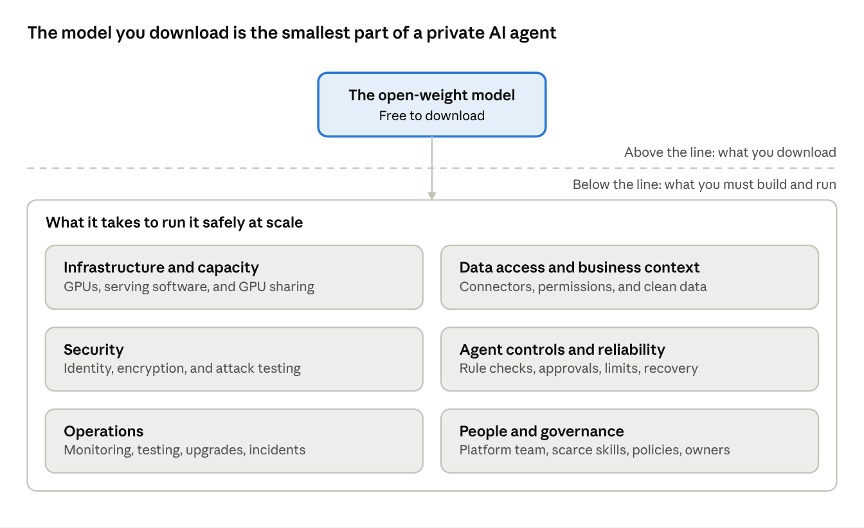
What you download vs. what you must build · 1 model, 6 investments
A model on a server can answer a test prompt in a day. Making it safe to connect to your systems of record, at scale, for thousands of users and many agents, is a program, not a download.
2. Why security-minded companies still choose private
The case for private AI is about control, and the case has never been stronger. The best open models now sit only a few points behind the best closed models on broad benchmarks (Build to Launch). For most internal work, the quality gap is no longer the deciding factor.
What a private model gives you:
- Data control. Sensitive records, source code, and contracts never leave your environment.
- Regulatory confidence. You can show where data lives and who touched it.
- Cost predictability. Steady, high-volume workloads run on capacity you control, not per-token bills.
- Roadmap control. No vendor can retire or change your model on its own schedule.
- Deep customization. You can adapt the model to your language, tools, and processes.
What it does not give you is security, reliability, or readiness. Privacy decides where data lives. Security decides who and what can see data and take action. The rest of this paper is about closing that gap.
3. Agents raise the stakes
A chatbot answers questions. An operational agent reads live systems, makes decisions, and takes actions. That one change multiplies what a company must invest in, because the cost of a mistake changes.
| AI assistant | Business-critical agent | |
|---|---|---|
| What it does | Answers and drafts | Decides and acts in systems of record |
| Worst likely mistake | A bad answer someone ignores | A wrong payment, order, or customer notice |
| What keeps it safe | The user’s judgment | Controls built around the model |
| What the company must invest in | A model and a user interface | A full operating system for AI |
The design rule for agents is simple: the model suggests; the system decides what is allowed. Permissions, rule checks, approvals, and audit trails must keep working even when the model is wrong or reads a malicious document. Building those safeguards is where most of the effort goes.
4. The six investments behind a private AI agent
Every company that runs private AI agents at scale ends up funding the same six areas, whether it builds them, buys them, or partners for them. None of them is optional for business-critical work.
| Investment | What it takes | Why it is hard |
|---|---|---|
| 1. Infrastructure and capacity | GPUs, networking, serving software, capacity planning, and GPU sharing across teams | Expensive hardware sits idle unless shared; needs grow with users and document size |
| 2. Data access and business context | Secure connectors to ERP, CRM, finance, and documents; permission mapping; data cleanup; business definitions | Legacy systems, messy data, and permissions that must follow each user |
| 3. Security | Identity for every user and agent, defenses against prompt injection, encryption, hardened endpoints, red-team testing | Attacks arrive in plain language; private does not mean secure |
| 4. Agent controls and reliability | Rule-based checks, approvals, limits, safe retries, recovery, and kill switches | Must work even when the model is wrong, and must be proven against failure cases |
| 5. Operations | Round-the-clock monitoring, quality testing, upgrades, incident response, and cost tracking | Answer quality can slip silently; every change needs re-testing |
| 6. People and governance | A platform team, scarce AI engineering skills, a review board, policies, and clear owners | Skills are hard to hire; ownership spans IT, security, legal, and the business |
Notice that none of these is the model itself. And most are not one-time projects. They are permanent capabilities the company must keep running.
5. What the investment really looks like
The model is free to download. The system around it is not. Leaders should plan for three kinds of investment: capital, people, and time.
| One-time investment | Ongoing investment | |
|---|---|---|
| Technology | GPU capacity, serving and gateway setup, connectors, security controls | Hardware refresh, software updates, model upgrades every few months |
| People | Architecture, integration, and security design | A standing platform team, on-call support, red-teaming, evaluation |
| Process | Policies, risk tiers, approval rules, test sets | Reviews, audits, and incident drills |
| Business | Process mapping, success measures, change management | Training, adoption, and measuring business results |
People are the scarcest resource. A private AI program needs skills most companies do not have in depth: model serving, GPU operations, AI security, and evaluation. It also needs business owners who can judge whether an agent’s decisions are right.
Time to value is measured in months. A first production agent of medium complexity often takes several months and a cross-functional team spanning AI, data, applications, infrastructure, security, quality, and business operations. Legacy integration, criticality, and compliance drive the real timeline.
Judge the investment by outcomes. The right measure is not cost per token. It is the total cost, over three to five years, of each completed and validated business task, including the people who keep it safe.
6. A phased path
The safest way to make this investment is in stages, opening each phase only when the last one has proven itself.
Adoption roadmap · 4 phases, 3 gates
The gates matter more than the dates. Autonomy should grow the same way: the agent observes first, then recommends, then acts with approval, and only then acts alone within tight limits.
7. The integrated platform opportunity
Most of the six investments are the same for every agent a company builds. Funding them once, as a shared foundation, avoids rebuilding the same stack for each project. Reuse improves consistency and shortens time to value as adoption grows, provided the foundation proves the controls described in this paper.
Amberd’s perspective
This section states the publisher’s point of view. It is a positioning statement, not an independent verification of features or security controls.
Amberd is built as a platform to construct, control, and manage AI agents on private infrastructure, including agents a company already runs. It connects enterprise data, supports agent development, and governs AI applications inside the customer’s own controlled environment. Private deployment is the starting point, not an add-on.
The goal is to let companies spend their effort on business decisions and outcomes, not on reassembling the same AI technology stack for every project.
As with any vendor, buyers should validate the actual release, connectors, deployment setup, governance functions, and service commitments through a technical evaluation.
8. Conclusion
Open-weight models have removed the last good excuse not to run AI privately. They have not removed the work. For a company that cares about security and control, the model is where private AI begins, not where it ends.
The winners will be the companies that treat private AI as a long-term operating capability, budget for the full system rather than the model, and decide clearly what to build, what to buy, and who owns the result.
The future of enterprise AI will be decided not only by how smart models become, but by how safely and economically companies can apply them to real operations.
References
- Open-Source LLMs in 2026: What’s Actually Open, and How to Pick One, Build to Launch, July 2026
- OWASP’s 2026 LLM Top 10 and New Agent Control Standard, Cloud Security Alliance, September 4, 2026
- AI Risk Management Framework and Generative AI Profile, NIST AI 600-1, NIST
- EU Digital Omnibus on AI Enters Into Force, National Law Review
Editorial note: Product capabilities, implementation assumptions, and regulatory duties should be validated for each enterprise environment. This white paper is informational. It is not legal advice or a security certification.